Dementia Science Programme
(A DBT Funded National Level Research Programme)
Dementia Science Programme
Dementia is a devastating memory impairment condition. Alzheimer's disease accounts for majority of the dementia cases. It is a neurodegenerative condition that eventually results in severe memory loss and impairment in other brain functions. Other dementia conditions include vascular dementia, dementia with Lewy body, and frontotemporal lobe dementia. With an improvement in the healthcare, nutrition and the rising income the number of people living to an advanced age has increased. An unfortunate consequence of increase in life expectancy is that more number of people now live with dementia. According to estimates, worldwide more than 40 million people have dementia. In India, more than 4 million people are living with dementia. It is projected that the number of dementia cases will increase tremendously in the coming years. According to the World Alzheimer Report, by 2050, the number of dementia cases in the world is likely to increase to more than 125 million. Out of these, majority of the cases will be in low and middle-income countries such as India. This will tremendously increase the healthcare as well as societal costs for the country.
Development of dementia, which is influenced by multiple socio-cultural and genetic factors, is less studied in India. Considering that it is a chronic disabling condition that consumes resources at the economic, social and psychological levels, longitudinal follow-up studies are vital for studying the conditions which lead to development and progression of dementia, and its impact at the level of family, community and the Nation.
Considering the urgent need to understand different facets of dementia, National Brain Research Centre is coordinating a DBT funded comprehensive national level Dementia Science Programme that will provide data regarding incidence, prevalence, possible biomarkers, and risk and protective factors. This multi-centric Programme involves basic scientists and clinicians from multiple sites across the country. For dementia diagnosis and classification, all the centres will use robust and uniform criteria that are internationally accepted, and adapted and validated for the Indian context. The programme also aims to set up, at NBRC, a Bio-repository of the samples collected from dementia patients that will serve as a valuable resource for further studies on biomarkers, genomics and proteomics. A database of the MRI brain images from the patients taken at multiple time points during the study will be created. Results from the study may help in formulation of National levels policies for this major cognitive disorder in the elderly population.
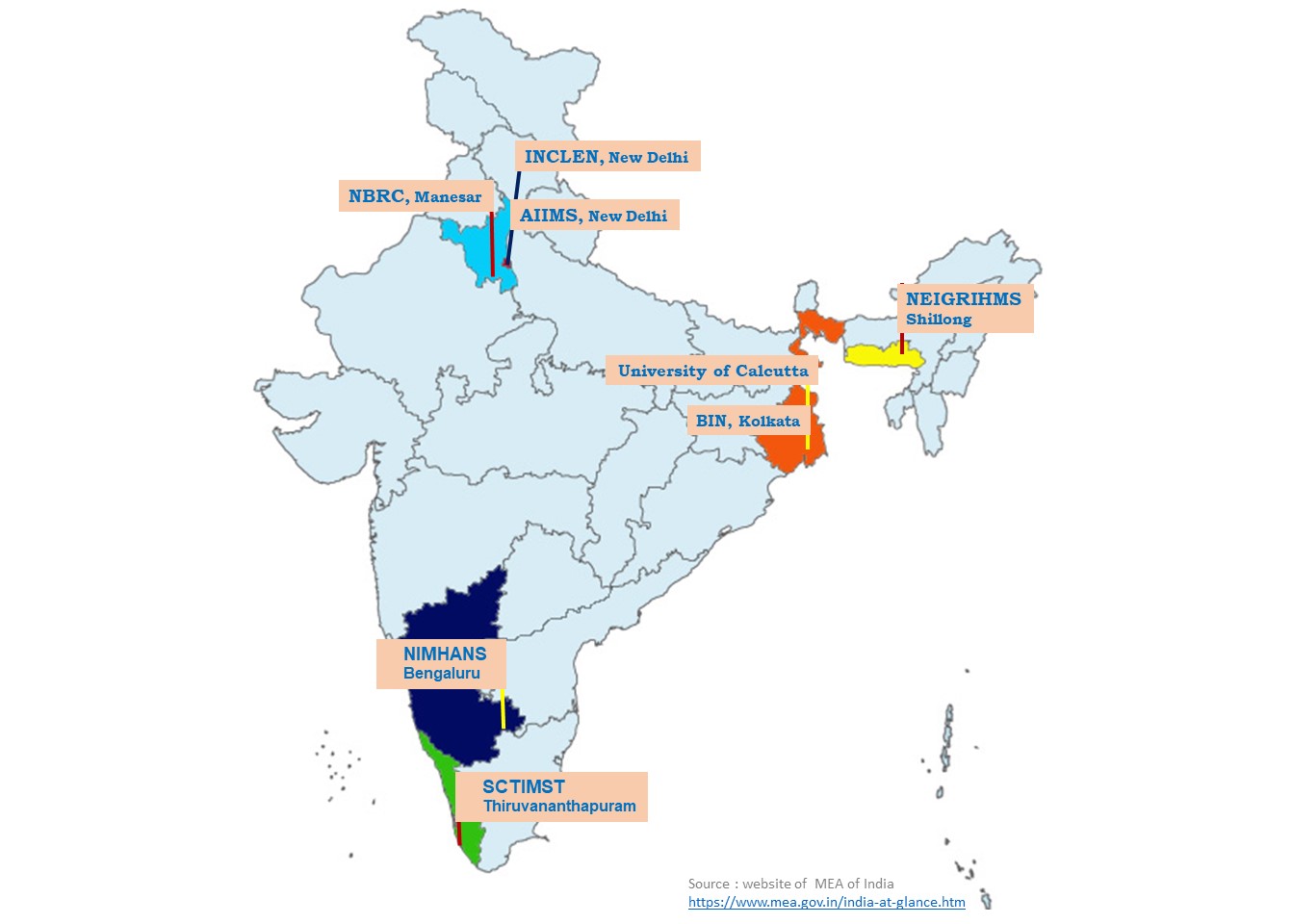
Participating Institutions in Dementia Science Programme are:
A. Community-based sites:
- North-East (Tribal): North Eastern Indira Gandhi Regional Institute of Health and Medical Sciences (NEIGRIHMS), Shillong
- South (Urban, Bengaluru): National Institute of Mental Health and Neurosciences (NIMHANS), Bengaluru
- North (Rural, Palwal): The INCLEN Trust International (INCLEN), New Delhi
B. Hospital-based sites:
- All India Institute of Medical Sciences (AIIMS), New Delhi
- Bangur Institute of Neurosciences (BIN), Kolkata
- National Institute of Mental Health and Neurosciences (NIMHANS), Bengaluru
- Sree Chitra Tirunal Institute for Medical Sciences and Technology (SCTIMST), Thiruvananthapuram
C. Basic Biology studies:
- National Brain Research Centre (NBRC), Manesar
- University of Calcutta, Kolkata
Director, NBRC is coordinating the Dementia Science Programme, with Dr. Shiv Sharma, NBRC, and Dr. NK Arora, INCLEN Trust International as co-coordinators.
